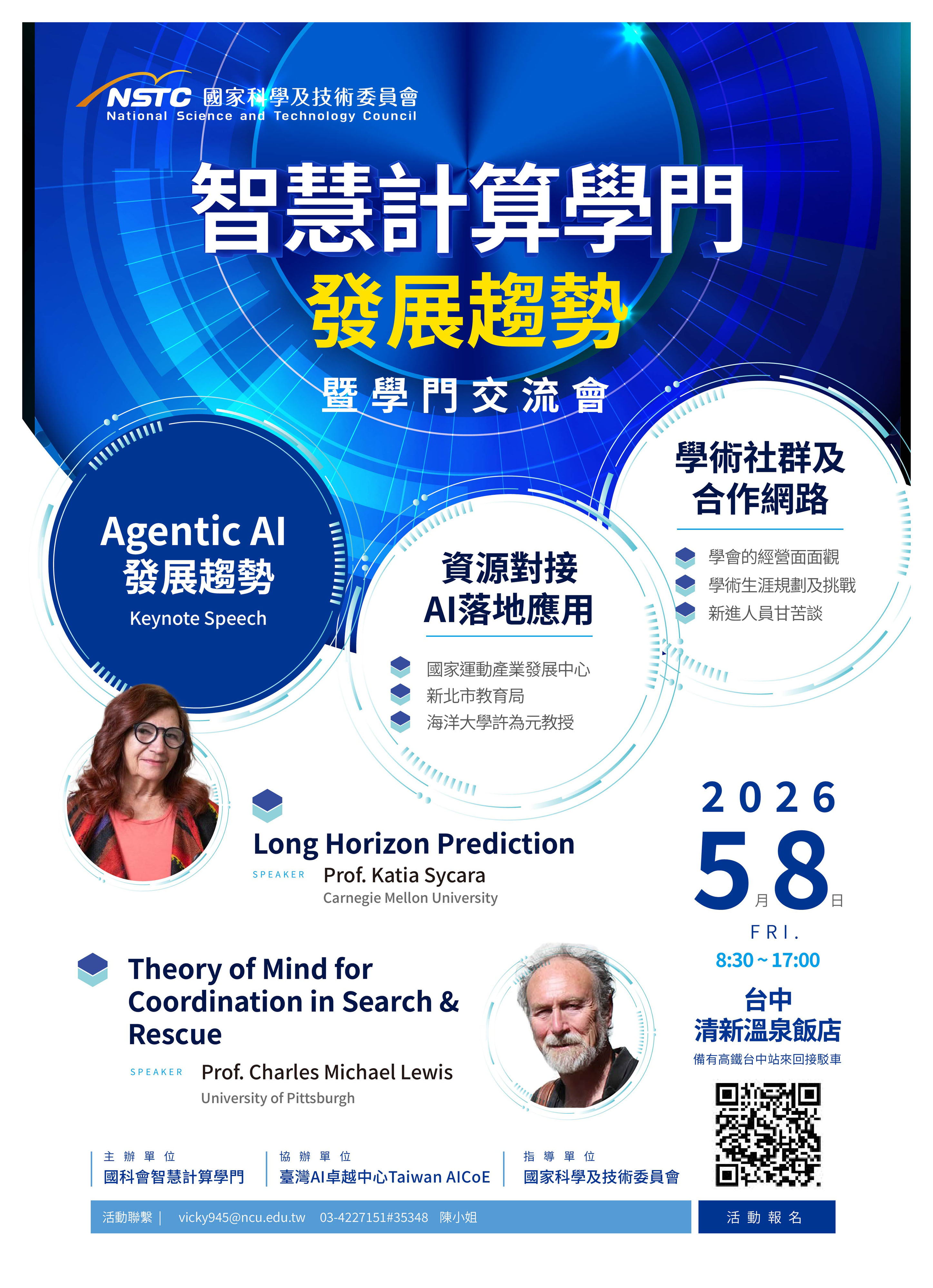
活動海報 (Poster)
專題演講 (Keynotes)
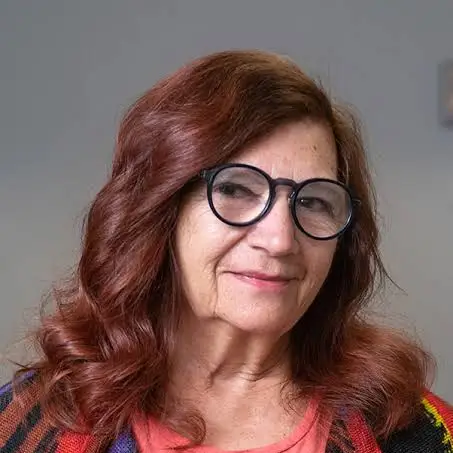
Prof. Katia Sycara
"In this talk we present our work on predicting long-horizon sequence of actions from short-observation contexts. In a demonstration with a robotic manipulator, we show that predicting human intention in this way leads to effective collaboration between humans and robots."
Katia Sycara is the Edward Fredkin Research Professor in the School of Computer Science at Carnegie Mellon University and a Research Professor at the Robotics Institute. She is a leading expert in artificial intelligence, multi-agent systems, and human-agent collaboration.
Her research spans AI autonomy, distributed intelligent systems, and trust in human-AI interaction, with applications in robotics, defense, and large-scale information systems. She has been a pioneer in agent-based systems and has made significant contributions to semantic web technologies and collaborative AI.
Professor Sycara has received numerous honors, including recognition as a Fellow of the Association for the Advancement of Artificial Intelligence and the Institute of Electrical and Electronics Engineers. She has also served in key advisory roles for government and international research initiatives, and her work has had a lasting impact on the development of intelligent, cooperative systems.
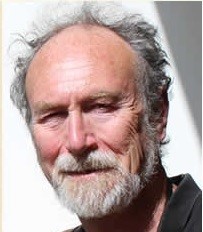
Prof. Michael Lewis
"Theory of Mind entails predicting the evolving beliefs of other actors often under conditions of partial observability. Predicting the actions of others based on what you believe they believe to be true rather than your own beliefs can improve accuracy and therefore coordination. We describe three studies in which team performance is improved by incorporating Theory of Mind. In the first, human agent teams perform a bomb defusal task in which agents have access to different tools which must be applied in particular sequences. An advisor models the beliefs of the human participant to identify situations to intervene in which the human is expected to make the wrong decision. In the second study LLMs coordinate to perform the task and when prompted to update models of one another's beliefs reach a solution in half the time. In the third study OverCooked players infer the roles of their teammates to predict their actions allowing few-shot adaptation."
Michael Lewis is a Professor at the School of Computing and Information at the University of Pittsburgh. Trained in engineering psychology, his research focuses on human-computer interaction, human-agent teaming, and swarm robotics. He investigates how humans interact with complex autonomous systems, with particular emphasis on trust, decision-making, and coordination in multi-agent environments.
His work integrates artificial intelligence, visualization, and human factors to improve the effectiveness of human-AI collaboration. Professor Lewis has led and contributed to numerous research projects supported by agencies such as DARPA, NSF, and other U.S. government organizations. He has published extensively in leading journals and conferences in human-machine systems, robotics, and AI.
專題座談
與談者陣容
專題座談「資源對接、AI落地應用」
- 國家運動產業發展中心 黃進來 副執行長
- 新北市教育局 張明文 局長
- 海洋大學 許為元 教授
- 主持人:洪盟峯 教授
由三位來自不同領域的產官學代表,解鎖跨域資源,加速 AI 應用實戰落地。
交流活動
世界咖啡廳
桌長
- 洪盟峯老師 / 高雄科技大學
- 盧文祥老師 / 成功大學
- 謝君偉老師 / 陽明交通大學
- 陳宜欣老師 / 清華大學
交流目標
透過分組輪轉、重點彙整與跨組分享,串連不同領域觀點,形成可行的合作主軸與後續行動方向。
活動議程 (Agenda)
| 上午 專題演講 | |
|---|---|
| 08:30 - 09:00 | 報到 |
| 09:00 - 09:10 | 開幕致詞 |
| 09:10 - 10:00 | Keynote Speech: Long Horizon Prediction - Prof. Katia Sycara (CMU) |
| 10:00 - 10:20 | Break Time |
| 10:20 - 11:10 | Keynote Speech: Theory of Mind for Coordination in Search & Rescue - Prof. Michael Lewis (PITT) |
| 11:10 - 12:10 | 專題座談:解鎖跨域資源,加速 AI 應用實戰落地 |
| 下午 交流會 | |
|---|---|
| 13:30 - 14:00 | 報到 |
| 14:00 - 14:10 | 共同開場:說明交流目的、原則與流程 |
| 14:10 - 14:40 | Round 1:初步探索 |
| 14:40 - 15:10 | Round 2:觀點串連 |
| 15:10 - 15:30 | 茶會交流(午茶時光,自由交流互動) |
| 15:30 - 16:00 | Round 3:共識收斂 |
| 16:00 - 16:40 | 各組分享結論(每組約 10 分鐘,由桌長或組員代表分享) |
| 16:40 - 16:50 | 活動結語 |
| 16:50 | 準備賦歸 |
地點資訊 (Location)
地點:台中 / 清新溫泉飯店
前往飯店網站
交通:備有高鐵台中站來回接駁車,詳情請留意後續行前通知。